Covid has highlighted the need for union learning
I have worked for the Bakers, Food & Allied Workers Union for 20 years helping people in the workplace access learning. This is a service for everyone whether or not they are a union member.
I am working with Hovis, Warburton and Greggs nationally as well as Signature Flatbreads, Dunstable; MyFresh Prepared, Chicksands; and Brioche Pasquier, Milton Keynes. I cover middle England for want of a better description travelling across to Hovis, Avonmouth in the West and then Quorn Foods, Norfolk in the East.
I want to tell you about the importance of union learning and how funding has enabled me to access disadvantaged learners in the workplace and the other services we offer.
There are a lot of workers in the factories whose first language isn’t English and they cannot get access to college programs either because of the cost or the times the courses are on. They rely on others to translate and explain rules and regulations such as Food Hygiene, Health & Safety and other procedures around clocking in/out right down to parking; this can leave them very vulnerable and open to disciplinary if mistakes are made or they get the wrong information.
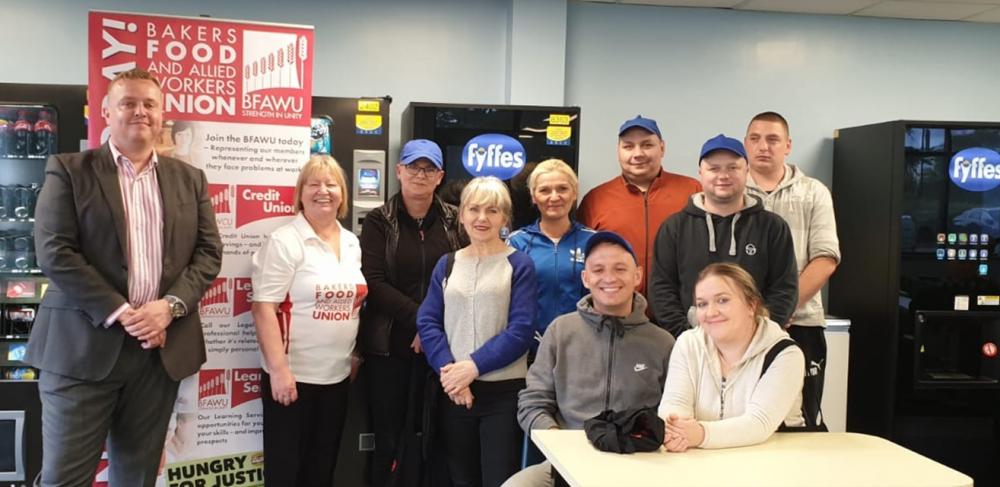
As a project worker for the BFAWU I work with HR and the reps to establish the best way of targeting learners. I go to various workplaces and set up in the canteen giving information about courses and taking the names of those who have expressed an interest to learn.
There was a lot of funding for ESOL but this was cut over ten years ago removing the college support we used to have. Most of the learners have a basic knowledge of English so when we have run courses in the workplace they would do their assessments and the majority would come out at Entry Level 1 or 2; this gives them access to the Functional Skills programs.
For those who didn’t make the criteria the tutor and I had a conversation about how we could help them. We looked at the fundamentals of English and put together a basic workbook using the alphabet, colours, numbers and everyday conversational English. I was able to teach this in one room while the tutor was teaching in another; this helped to push the learners and get them over the line to start their functional skills proper. My learners were bringing in application forms for schools and housing as they weren’t sure how to fill them in so we were able to incorporate that into the learning.
Most workplaces will give us a room to work in and provide equipment like overhead projectors, some will give a 50/50 split on time to learn; this means they give an hour at the end of the shift while the learner stays on for an hour to complete their learning which is usually in two hour sessions. We will provide the basics i.e. pens, pencils, paper etc. but crucially we can provide a friendly ear for those with problems or anxieties.
Learning at work has provided a friendly environment for those who just cannot find the time to attend college, or indeed, work long hours. They are learning in a place they are familiar with; it’s not scary; they don’t have to go home and then out again; the list of positives can go on.
We work with a range of providers, not only having access to Functional Skills but to online courses at Level 1 and 2. These can include a range of courses applicable to the Care Sector, Mental Health, Digital Skills and many others such as Team Leading, Business Management and many others that can be used in the workplace and to enhance the persons CV.
During the COVID pandemic we have helped people remotely with dealing with redundancies. I worked with people in Wakefield after the Speedibake bakery was destroyed by fire and the workforce were made redundant; not only did I help them complete their CVs but apply for jobs and secure interviews as well.
Not everyone has the computer skills needed to circumvent the jobs market but through the Union Learning Fund we can be there to help and at these times I can see that even more help will be needed in the future.